CONGRESS TRADING TRACKER
Track Congress trades, with the delay on the record
Members of the House and Senate are required by the STOCK Act to disclose their trades. GetSignal reads each filing as it lands, pushes it to your phone, and shows exactly how long the member waited to report it.


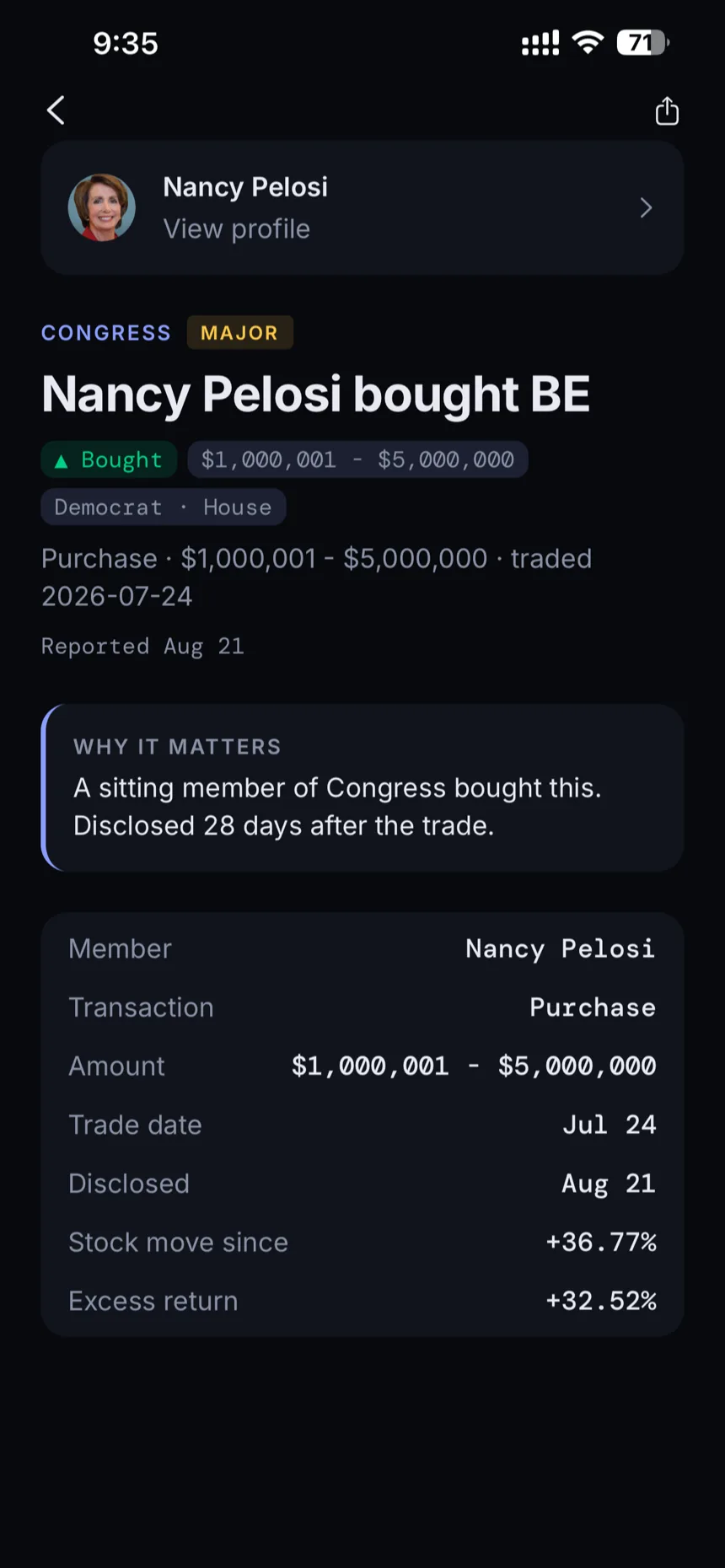
How the STOCK Act works, and its 45 day window
The STOCK Act, passed in 2012, requires members of Congress to publicly disclose their securities trades. When a member of the House or Senate buys or sells a covered security, they must file a periodic transaction report, and the law gives them up to 45 days to do it. Those reports land on the official House and Senate disclosure portals, where anyone can read them.
In practice, the raw filings are awkward to use. Transaction sizes are reported in broad dollar ranges rather than exact amounts, the two chambers publish through separate systems, and there is no built-in way to get notified when a specific member files. If you want to follow a handful of members, you are left refreshing two government websites and reading scanned forms.
GetSignal does that work for you. It picks up each new disclosure through its congressional data feed, normalizes it into a clean event, and delivers it through one feed with category filters, so Congress trades sit alongside insider trades, 13F fund moves, and earnings for the tickers you care about.
Why the disclosure delay is the real story
Every Congress trading headline skips the most important number: how old the trade is. A disclosure published today can describe a trade made up to 45 days ago, entirely within the law. Anyone reading the filing as if it were fresh is working with stale information and does not know it.
That is why GetSignal treats the delay as a first-class fact. Every Congress trade in the app shows the trade date and the filing date side by side, with the gap between them counted in days. You always know whether you are looking at last week's decision or last month's.
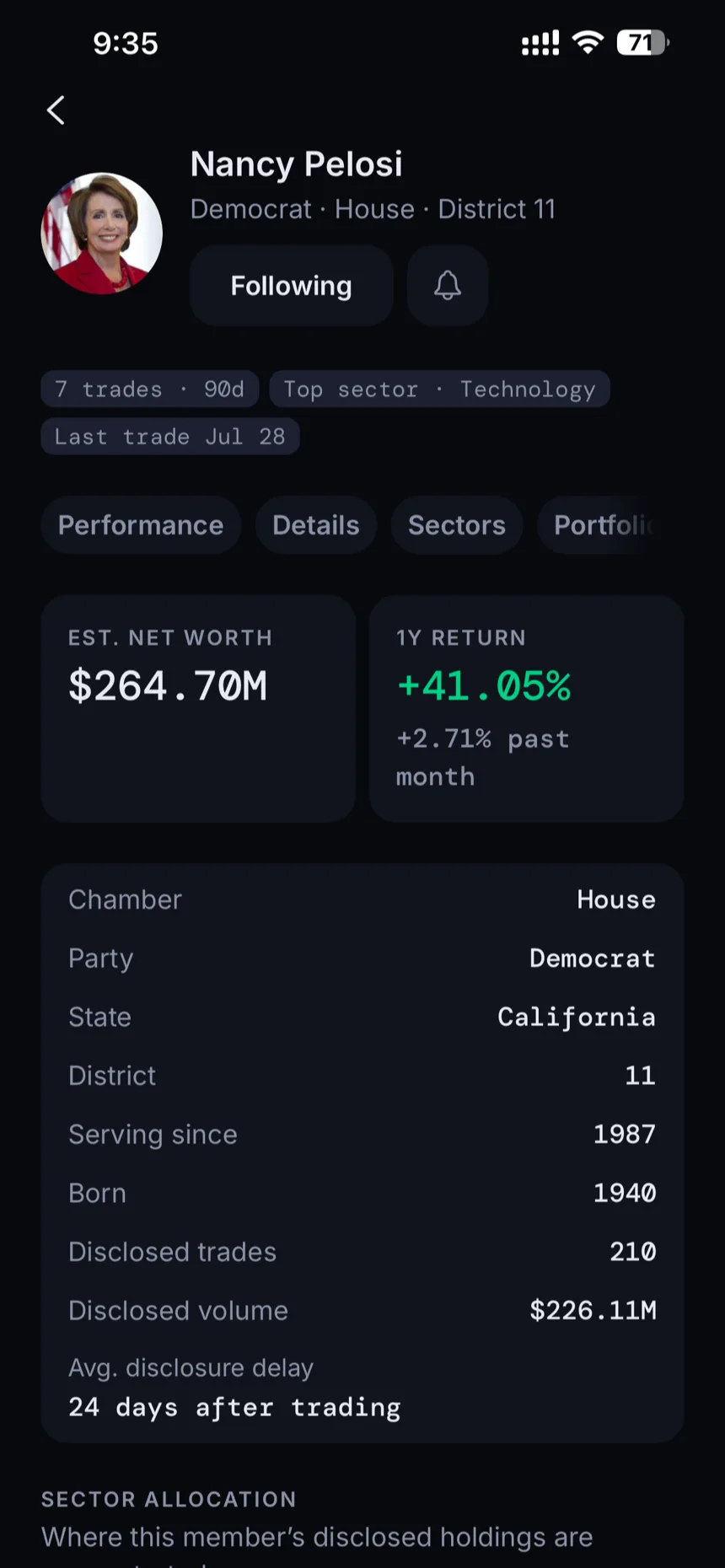
The delay is also a pattern worth watching per member. Some members file within days, others routinely use most of the window. GetSignal computes an average disclosure delay for every member profile, so when a new filing arrives you can put it in context: is this member usually prompt, or does their paperwork tend to show up late? No judgment attached, just the record, measured.
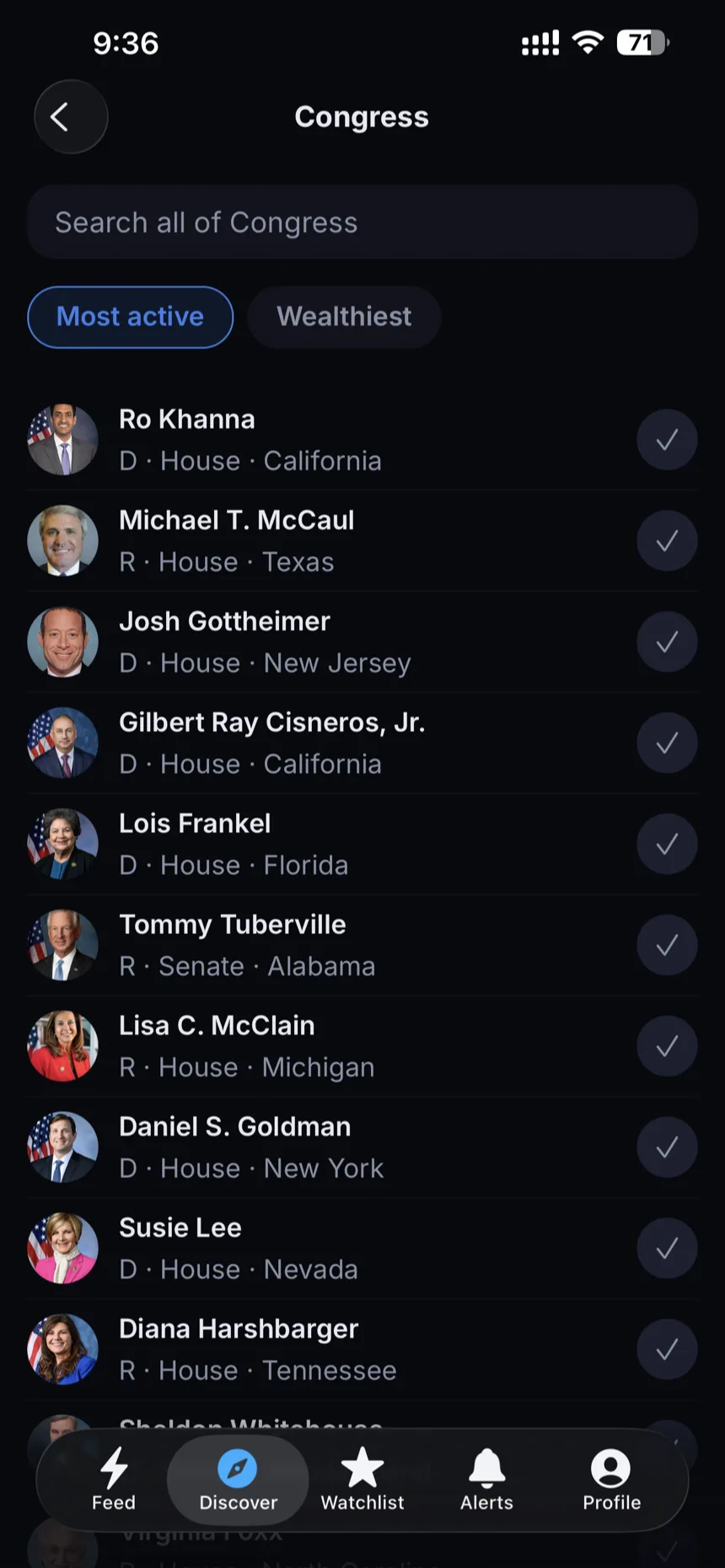
Pick the members you want to watch
GetSignal leads with the members who trade most, so you can start with the names that file most often. Search the full House and Senate whenever you have someone specific in mind.
- The most active traders lead the list
- Search the House and the Senate by name
- Party, chamber and state on every row
What a member profile shows you
Open any member in GetSignal and you get a working profile, not just a list of headlines. It starts with an estimated net worth built from the member's own range based disclosures. Because the underlying filings use ranges, the figure is an estimate, and GetSignal labels it as one instead of pretending to precision the data cannot support.
Below that sits the trading record: every disclosed trade with its trade date, filing date, and days-late count, a 1 year return estimate, a sector allocation view of where the member's disclosed positions sit, and the average disclosure delay. The methodology screen links straight to the official House and Senate portals so you can check the primary record yourself.
You can also read the disclosures on the web without installing anything: every member we hold filings for has a page listing their trades and how many days each one took to reach the public.
If you ever wonder how a number was produced, the methodology screen in the app explains each figure, which ones are estimates, and why. GetSignal's position is simple: show the public record clearly, label every assumption, and let you draw your own conclusions.
How alerts work when a member you follow files
Follow a member and GetSignal pushes a notification when their next disclosure lands, usually within minutes of publication. Alert rules are yours to shape: pick which event types trigger a push, set an importance floor from Routine up to Major so small updates stay quiet, and set quiet hours and a daily cap so your lock screen stays usable.
A free account gets one alert rule, and the rule it starts with covers every name it follows. Signal Pro raises that to 20, so a member can carry its own settings, along with unlimited follows and full feed history. The free plan includes 10 follows and 30 days of history, which is plenty to start following the members whose committees overlap with your watchlist. Details are in the pricing section.
A Congress feed built for reading, not refreshing
Everything above ships in the app today, in one feed you can filter down to Congress trades only.
- Follow any member of the House or Senate
- Push alerts minutes after a filing, with per-rule event types and an importance floor
- Trade date, filing date, and days-late shown on every disclosure
- Estimated net worth, 1 year return estimate, and sector allocation per member
- Average disclosure delay on every profile
- Links to the official House and Senate portals, plus a methodology screen
Congress trading tracker FAQ
How quickly do Congress trade alerts arrive?
GetSignal polls for new STOCK Act filings every 15 minutes, around the clock, and pushes an alert as soon as a disclosure appears. Keep in mind the trade itself may be older: the law allows up to 45 days between the trade and the filing, which is why GetSignal shows both dates on every event.
Do members of Congress report exact trade amounts?
No. STOCK Act filings report transaction sizes in broad dollar ranges rather than exact figures. GetSignal works with those ranges honestly: portfolio and net worth figures on member profiles are estimates derived from range based disclosures, and they are labeled as estimates in the app.
Can I track both the House and the Senate?
Yes. GetSignal covers both chambers. You can follow any member of the House or Senate, browse their profile, and get a push alert when someone you follow files a new disclosure.
Where does the Congress trading data come from?
From the official STOCK Act disclosures that members are legally required to file. GetSignal links to the House and Senate disclosure portals from inside the app, and a methodology screen explains where every figure comes from and which numbers are estimates, so you can always check the primary record yourself.
Is a Congress trading tracker investment advice?
No. GetSignal surfaces public disclosures, full stop. It does not make recommendations, execute trades, or promise any outcome. What you do with the information is entirely up to you.
Know when Congress files, not weeks later
Free to start. The Pro trial runs through the App Store or Google Play and becomes a paid subscription unless you cancel. Not investment advice.